The Saudi crisis
MADRID — The writing of history rests on the selective erasure of certain pasts, and of the artefacts bearing witness to them. From the omission of archive documents to the demolition of sacred and secular spaces, every act of destruction is also an act of state-building.
Saudi Arabia may be the paradigmatic case of this construction. After the 1991 Persian Gulf War, the Kingdom's political elites pursued with renewed fervour two parallel projects, historical commemoration and state-building, to impose their postwar vision on the state, the nation and the economy.
Not only has the Kingdom "hidden" the transnational, transoceanic intellectual exchanges predating 1932; in recent years King Salman has aggressively pushed a reformulated, secularised historical narrative. The country's "archival performance", marked by inefficiency, sabotage and coercion, betrays "conflicting visions of the past" and a sometimes fragile grip on power. From its establishment, the family's authority rested largely on American corporations, ARAMCO above all, and on the United States government, which shielded it from widespread, if erased, anti-colonial and anti-authoritarian mobilisation at home and from regional rivals. Yet the struggle to hold power on its own terms made plain the need for a state-sanctioned historical narrative.
The desire to control the narrative is not merely an archival matter. In 2009, Prince Khalid bin Sultan led Operation Scorched Earth, a Saudi intervention in Yemen that quickly became a quagmire and ended in humiliating retreat. The official narrative never admitted failure, but Khalid's later disappearance from public life suggests he was made to shoulder the blame.
In 2015 King Salman appointed Muhammad bin Nayef crown prince. Interior minister and supporter of the Yemen intervention, his rise let him coordinate the campaign against Ansarallah more effectively. The Saudi bombing, even with American intelligence support and aerial refuelling, was a new disaster. In 2017 the king replaced him with his son, Mohammed bin Salman, who quickly came to the fore, launching the ambitious Saudi Vision 2030: an attempt to rebuild the country in material as much as ideological terms.
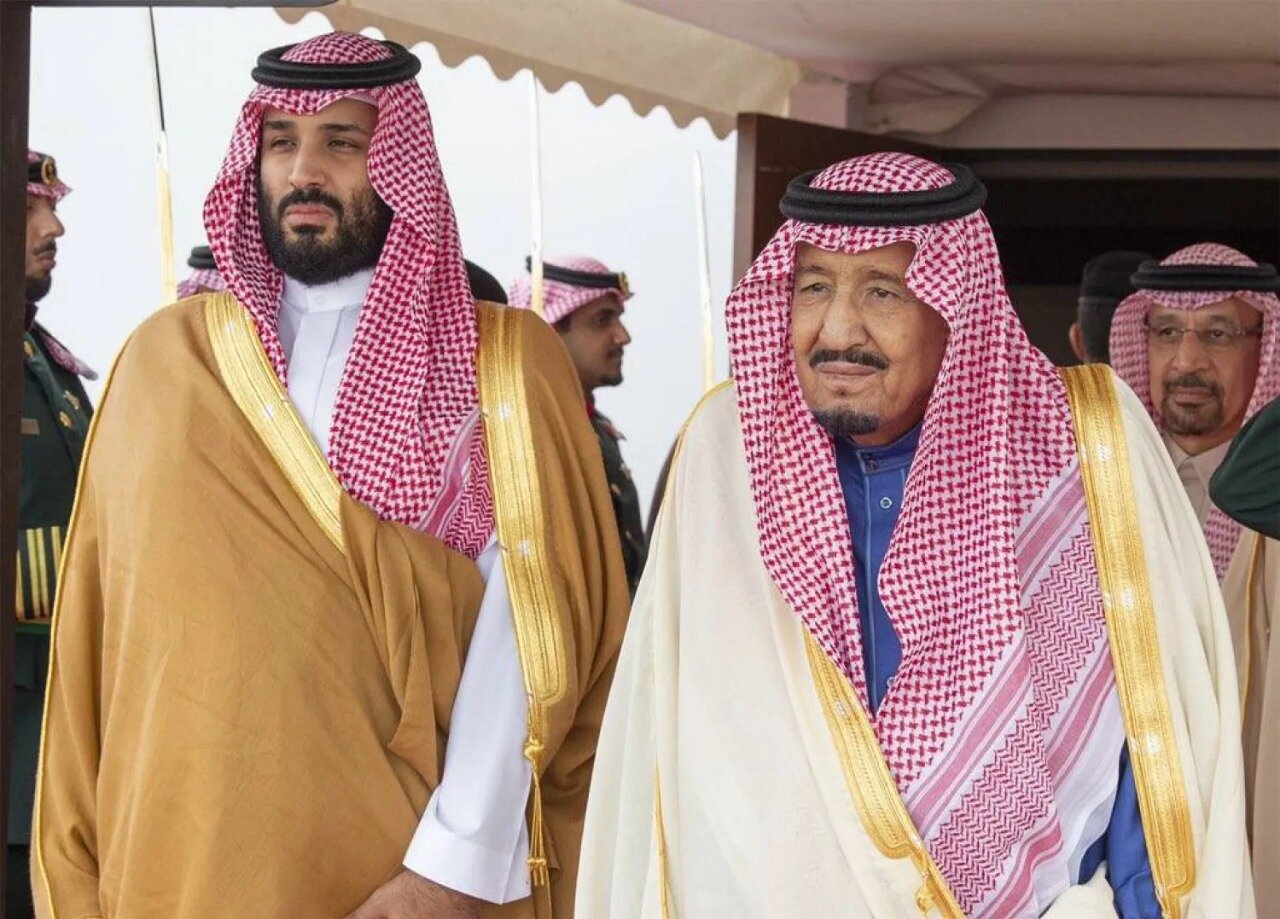
The project teems with futuristic cities, the relaxation of symbolic social norms, such as granting women the right to drive, and new arts centres, like the modern art museum announced in 2019. These are among the ventures King Salman bin Abdulaziz and Crown Prince Mohammed bin Salman have promoted to project a more secular image of the Kingdom. And this, once again, is an attempt to control the archive: to decide which pasts are valid, which are left out of the present and which, at the same time, can be projected into the future.
Despite Bin Salman's efforts, the royal family remains fragmented; its members pursue their own economic and political agendas, often at the expense of relatives, regional and religious authorities, and Saudi citizens. Yemen is no exception. Prince Ahmed bin Abdelaziz, one of the few surviving sons of the kingdom's founder, said years ago in London that the region's disastrous Saudi policy was the exclusive responsibility of the king and his heir.
Bin Salman's Yemen policy has been a tremendous failure. But, as before, a struggle for control of the archive endures, and those with the greatest resources at their disposal, as in this case the crown prince, have managed not to explicitly acknowledge that failure or the situation in which the Kingdom now finds itself.
Since the war began, many wondered why Ansarallah kept to the sidelines even when Hezbollah opened a front in northern Israel. The only plausible explanation I found was that the Houthis were acting as a counterweight to the Saudis. Iran was striking bases across the Persian Gulf and had closed the Strait of Hormuz, forcing Riyadh to divert much of its crude to the Red Sea terminals. The Saudis wanted no further escalation.
Yet it remains a mystery why the Saudis attacked an airport in Yemen earlier this month, just as the United States resumed air strikes against Iran. The ceasefire benefited Saudi Arabia. Ansarallah responded with attacks and blockaded the Saudi ports on the Red Sea; the Saudis struck back, and now the Houthis are hitting Saudi oil facilities. The Kingdom has been dragged into open war.
If only months ago Saudi Arabia could be called a regional pole of power, it now finds itself in a tremendously delicate position. Its energy system is under siege on three fronts, a critical inflection point in the region's energy geopolitics: coordinated attacks from Iraq and Ansarallah's gains in Yemen have struck the core of Riyadh's oil infrastructure while Hormuz stays closed.
The economy contracted 4.8% in the second quarter, the largest year-on-year fall since the 2020 COVID-19 peak, owing to five months of war in Iran and the near-total closure of Hormuz. Oil output shrank 24.7% year on year between 1 April and 30 June, the Saudi statistics authority reported on Wednesday. Hydrocarbons supply some 55% of government revenue, so the slump dragged the economy down. Oil subtracted 5.4 percentage points from annual GDP growth, while non-oil activities and government added just 0.6% and 0.9%.
Analysts describe a Kingdom in strategic shock; all analyses point to the economic situation worsening in the months ahead.
Leave a Comment